EcoArts Labs: Exploring the Circular Economy Through Art

Updated: Aug 30
We are surrounded by materials and objects that have stories much longer than the time we spend with them. A piece of packaging might be in our hands for a few minutes, a shirt might be worn for a few years, and a piece of furniture might stay in a home for decades, but none of these things simply appear and disappear. Each one has a history that begins somewhere and continues long after it leaves our hands.
Thinking about those stories can change the way we see the things around us, particularly when we begin to consider them as part of larger cycles rather than isolated objects.
The natural world gives us plenty of examples of this kind of thinking. Leaves fall and become part of the soil, plants produce seeds that lead to new growth, and nutrients move through ecosystems in ways that allow life to continue. The seasons themselves follow a cycle, bringing familiar changes while never quite repeating themselves in exactly the same way.
Phenology is the study of these seasonal changes and the timing of natural events. It can involve observing when plants begin to flower, when birds arrive or migrate, or when insects emerge as the weather changes. What makes phenology interesting is not simply the act of recording these events, but what we begin to notice when we look at them together. Patterns emerge,
relationships become easier to see, and the natural world starts to look less like a collection of separate things and more like a network of connections.
That idea of looking at the bigger picture can be useful when we think about the things we make and use as well.
Many of the systems behind our everyday products are designed in a fairly straight line. Materials are extracted, turned into products, transported, purchased, used, and eventually discarded. Because we usually encounter only the finished product, it can be easy to forget everything that happened before it reached us and everything that happens after we are finished with it.
A plastic container is a simple example. We might use it for a few minutes before putting it in the garbage or recycling, but the material has already travelled a much longer journey. It began with natural resources, moved through extraction and manufacturing, travelled through transportation and distribution, and eventually became the object sitting in front of us. When we are finished with it, another part of the journey begins.
The circular economy asks us to pay more attention to that journey and to consider what might happen if we stopped treating disposal as the inevitable end. Repairing an object, reusing a material, sharing something with someone else, finding a new purpose for an old item, or passing something along when we no longer need it can all help keep materials in use for longer.
These are not necessarily complicated ideas. In fact, many of us already practice them in small ways without thinking of them as part of a circular economy. We save jars because they might be useful later, mend something rather than replacing it, give unwanted clothing to someone who can use it, or keep leftover materials for a future creative project.
This is one of the reasons we are interested in exploring the circular economy through our EcoArts Labs, a series of community based sessions that use creative practice to explore environmental ideas. Art gives us a chance to slow down, look closely, and work through ideas in ways that do not always happen when we are simply reading or talking about them.
For our upcoming session, we are bringing phenology and circular thinking together through an adaptation of the phenology wheel. Traditionally, a phenology wheel is used to observe seasonal changes throughout the year, with different observations arranged around a circle. We are taking that familiar format and using it to explore the life of a material.
The centre of the wheel begins with the material's geological origins, then moves through extraction, manufacturing, distribution, and use. From there, rather than stopping at disposal, the circle opens into possibilities such as repair, reuse, redistribution, and transformation within a community.
The purpose is not to create a perfect map of a material's entire life. Instead, the wheel gives us a way to slow down and ask questions that we might not normally think about. Where did this material come from? What happened before it reached us? What decisions shaped its journey? Where could something change, and what might allow the material to remain useful for longer?
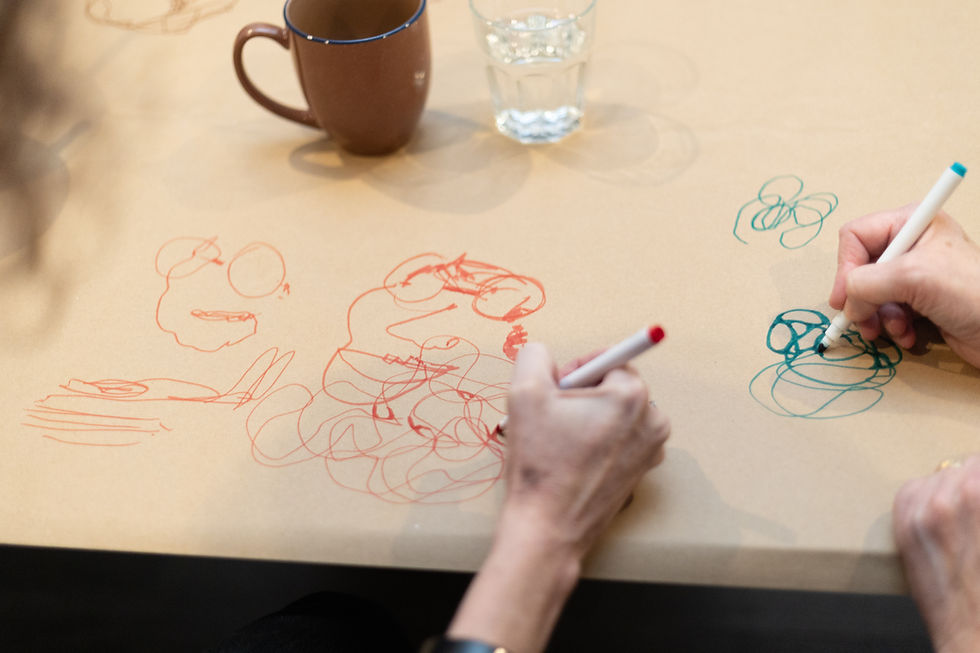
Through drawing, mapping, collage, and mixed media exploration, participants will be able to explore these questions creatively and see how individual objects connect to much larger systems.
There is also something very community oriented about circular thinking. Sharing resources, exchanging knowledge, repairing things together, and finding new uses for materials are not only environmental practices. They are ways of building relationships and making better use of what we already have.
Artists have long understood the creative possibilities that can emerge from this approach. A leftover piece of fabric can become part of another artwork, an old object can become a source of inspiration, and materials that might otherwise be discarded can take on an entirely new purpose. Creative practice often asks us to look at what is already in front of us and imagine what else it could become.
That way of looking at things can be useful beyond the studio as well. Environmental issues can sometimes feel enormous, particularly when we encounter them through global statistics, complicated systems, and problems that seem far removed from our everyday lives. Following the story of one familiar object gives us somewhere more tangible to begin.
It can help us notice the resources behind the things we use, the people and systems involved in bringing them to us, and the possibilities that exist after their first purpose has ended. It can also remind us that the choices we make are connected to larger systems, even when those connections are not immediately visible.
Perhaps that is where the connection between phenology and the circular economy becomes most interesting. Both ask us to pay attention to what happens over time, to look beyond individual moments, and to notice relationships that might otherwise remain hidden.
Through EcoArts Labs, we want to create opportunities for our community to explore those kinds of connections through art and conversation. We are not looking for perfect answers or expecting everyone to become an expert in environmental systems. We are creating space to be curious, to ask questions, and to see familiar things from a different perspective.
Sometimes that is where change begins, not with knowing everything, but with noticing a little more than we did before.